A group of students from the University of Michigan - Master of Arts in Secondary Education (SMAC) attended the Macul conference in Grand Rapids, Michigan. As a participant in this group, I listened to various presenters share their innovative technologies which could be incorporated in the classroom. We also practiced live blogging a session in order to further refine our own technical skills.
Below is a Blog from the session titled "Inquiry in the Lab - Using Probeware to Experience Science". The presenter, Victor Chen, provided information on activities that he successfully incorporated in his classroom utilizing devices such as motion sensors, a pressure monitor (syringe activity) and an interesting site related to science. We hope you enjoy our blog.
Friday, March 12, 2010

Wednesday, February 24, 2010
Teaching Exponential Decay with Candy
 Motivating students to learn mathematics can be a challenge. However, this activity is sure to be a hit with your students. I used the activity below in my 8th grade mathematics class to illustrate an exponential decay relationship. By having the students remove the pieces of candy which land with the marked side up, they unknowingly collect data representing an exponential decay pattern. Students can evaluate this data in graph and table form to further study characteristics such as decay factor and initial value. This activity works with M&M's, Skittles or any candy that is marked on one side. If students have food allergies, pennies can be substituted.
************************************************************************************
Activity Directions:
1) Please wash your hands or use hand sanitizer before doing this activity. You need to have clean hands before starting this activity.
2) Form small groups of 4-5 people.
3) Please get the following materials:
• One metal tray
• 2 blue cups
• Bag of M & M’s
4) Count the M&M’s in your bag, and ensure that a "m" is stamped on each M&M. Non-visible m’s can be exchanged. You should have a 100 M&M’s in your bag.
5) Each person should record the data for this activity in the following table:

6) Each group is to shake their cup and spill their M-&-M's into their tray. Count the number of M-&-Ms that land "m"-side-up, then remove them from the tray and place them in a "holding" cup. Use the table above (labeled "# Spills", "# M-side-up", and "# Remaining"), record the appropriate numbers. Put the remaining M & Ms back into the shaking cup.
7) Repeat this cycle of spilling the candies into the tray, counting and removing those pieces that land M-side-up. Record the number removed until there are no candies left.
8) Graph spill number versus total number of M&M’s (Spill #, Total # M&M’s) on graphing paper.
9) Please answer the following questions:
A.) What type of function best fits your data (i.e. linear, exponential growth, or other?) and why?
B.) Please write the general equation for the function you selected above.
C.) What is the initial value?
D.) What is the decay factor?
E.) Please write the equation of the graph model (i.e. equation that best fits your collected data)
10) What did you learn doing this activity?
11) What questions do you still have?
Saturday, January 2, 2010
Where are the Role Models?
What does Henry Ford, Steve Jobs (Founder of Apple Computers), Whoopi Goldberg, Patrick Dempsey, Danny Glover and Leonardo da Vinci all have in common? Amazingly enough, all of these talented, successful people struggled with dyslexia during their childhood. They serve to inspire and remind us that given determination and will, overcoming personal obstacles is possible. Their success and dedication puts them in a unique class for which they can serve as role models for all of us.
As I finally had the opportunity to watch television over the winter break, I was disappointed by the frequency of the negative news reports in the media on today’s public figures. Reflecting on this past year (2009), celebrities such as Tiger Woods, Miley Cyrus, Michael Phelps, Britney Spears, and Michael Jackson were just some of the potential role models surrounded by much controversy and speculation. Although we may never know what personal struggles these prominent people experienced as children, the characteristics portrayed by the media often leave young people, and in particular students, struggling to find a role model to emulate.
News reports that motivate school-aged children and serve to build their confidence are seldom found in today’s media. Public figures and celebrities can have a significant impact on young people and as educators it is important to identify those who qualify as credible role models. However, finding the right role models to actively and consistently provide a positive influence on today’s youth and inspire them is not an easy task. As we start off the New Year, we have high aspirations for public figures and celebrities to fill the existing role model gap.
Fortunately, for dyslexic students there is a list of potential role models, consisting of famous, successful people who have overcome their struggles with dyslexia. Check out the following website to discover who else is on the list.
http://www.dyslexia-test.com/famous.html
As I finally had the opportunity to watch television over the winter break, I was disappointed by the frequency of the negative news reports in the media on today’s public figures. Reflecting on this past year (2009), celebrities such as Tiger Woods, Miley Cyrus, Michael Phelps, Britney Spears, and Michael Jackson were just some of the potential role models surrounded by much controversy and speculation. Although we may never know what personal struggles these prominent people experienced as children, the characteristics portrayed by the media often leave young people, and in particular students, struggling to find a role model to emulate.
News reports that motivate school-aged children and serve to build their confidence are seldom found in today’s media. Public figures and celebrities can have a significant impact on young people and as educators it is important to identify those who qualify as credible role models. However, finding the right role models to actively and consistently provide a positive influence on today’s youth and inspire them is not an easy task. As we start off the New Year, we have high aspirations for public figures and celebrities to fill the existing role model gap.
Fortunately, for dyslexic students there is a list of potential role models, consisting of famous, successful people who have overcome their struggles with dyslexia. Check out the following website to discover who else is on the list.
http://www.dyslexia-test.com/famous.html
Friday, December 11, 2009
Learning to use Live Blogging
Learning about new technologies as part of our professional development and for incorporating creative lesssons in the classroom has been an integral part of the University of Michigan School of Education program. To become familiar with a new application, it is often helpful to simply utilize the application in a fun way. Below is my first attempt to use "Coveritlive" to live blog the American Ninja Warrior television program on December 12th at 6:00pm. Tune in too find out which contestants actually make it through the obsticle course!
Monday, November 2, 2009
Using Video Games to Reinforce Key Physics and Math Concepts
As the popularity of video gaming continues to increase, teachers are starting to assess the usefulness of video games in the classroom for reinforcing key concepts. For example, the racing game, Forza, allows students to "tune" their car prior to racing. Key tunables include:
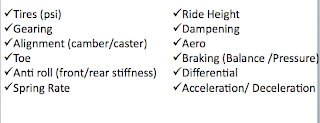 This game could be used to reinforce concepts related to friction and corresponding normal force (via tire pressure and performance trade offs), vehicle dynamics (e.g. acceleration/deceleration, momentum), dampening and concepts related to aerodynamics (e.g. drag)
Below is a video of a testimonial from a highschool student who enjoys playing Forza while at the same time has increased his understanding of automobiles and related physics concepts.
Friday, October 30, 2009
Explaining Pythagoreans Theorem with Clay-animation
Using clay-animation is a creative way to teach students mathematics concepts, such as the Pythagorean theorem. For example, the Pythagorean theorem is a relation in Euclidean geometry among the three sides of a right triangle.
The theorem can be written as:

Note the demonstration shows how the two blocks start out with equal area (comprised of red triangles and blue squares). Taking away the 4 red triangles from each side of the equation, results in one large blue box (equal to C squared) and on the right side of the equation there are two blocks (A squared plus B squared). By manipulating the blocks, students can better understand how this physical relationship can be true. Enjoy!
Tuesday, October 20, 2009
When students ask "Where does math come from?"
Many times students will ask "Where does math come from?" Interestingly enough many math courses only teach about formulas and problem solving, and never address this fundamental question. According to Greenberg (2008) the Greek historian Herodotus (fifth century B.C.) credits Egyptian surveyors, also known as "rope stretchers" with having originated the subject of geometry. Did you know the Egyptian priestly leisure class kept their math secret from the public? The Egyptians are also known for finding the correct formula for a truncated pyramid. According to Greenberg, the Babylonians were even more advanced than the Egyptians. They developed arithmetic using the base 60 (hexagesimal system). Today we use a decimal (10 base) system. The Hindu civilization on ancient India developed geometric information related to shape and sizes of altars and temples, and the Sulbasutra is one of the oldest mathematics texts currently known (~2000BC). Later, the Indians actually invented the number zero!
The ancient Chinese civilization also used math. According to Greenberg ancient China was mainly concerned about "practical matters" and developed the Nine Chapters on the Mathematical Art which included hundreds of problems on surveying, agriculture, engineering, and taxation (yes even math for taxation!). However, the Greeks ultimately developed and debated rigorous proofs. However, it doesn't stop there. Pythagoras was a spiritual leader, and along with his followers pursued mathematical studies. The Pythagoreans developed the concept of whole numbers and made observations regarding the length of vibrating strings with respect to harmonious sounds. These are just a few facts in a long line of mathematics history. To learn more you may want to check out Chapter 1 from the book Euclidean and Non-Euclidean Geometry by Marvin Jay Greenberg.
Information referenced in this blog taken from:
Greenberg, M. (2008). Euclidean and non-Euclidean geometries: Development and history. New York: W. H. Freeman and Company
The ancient Chinese civilization also used math. According to Greenberg ancient China was mainly concerned about "practical matters" and developed the Nine Chapters on the Mathematical Art which included hundreds of problems on surveying, agriculture, engineering, and taxation (yes even math for taxation!). However, the Greeks ultimately developed and debated rigorous proofs. However, it doesn't stop there. Pythagoras was a spiritual leader, and along with his followers pursued mathematical studies. The Pythagoreans developed the concept of whole numbers and made observations regarding the length of vibrating strings with respect to harmonious sounds. These are just a few facts in a long line of mathematics history. To learn more you may want to check out Chapter 1 from the book Euclidean and Non-Euclidean Geometry by Marvin Jay Greenberg.
Information referenced in this blog taken from:
Greenberg, M. (2008). Euclidean and non-Euclidean geometries: Development and history. New York: W. H. Freeman and Company
Sunday, September 20, 2009
Teaching students who are Dyslexic
Although many students struggle with math, it can be even more challenging for students who are dyslexic. Most people associate poor reading and writing skills with dyslexia, and recognize the traditional symptoms of switching or writing letters backwards. However, many people are surprised to learn that often dyslexic students experience difficulties in learning mathematics due to poor sequencing skills and issues related to short term memory required for tasks such as multiplication. At the most basic level many dyslexic students know very few addition and subtraction facts by memorization, and almost exclusively rely on special counting procedures (counting forwards and backwards) to work out simple addition and subtraction problems. Often, dyslexic students do not naturally use the facts they do know to solve related unknown problems, and will frequently make mistakes when executing counting. These students may also struggle with perceiving patterns in the number system and counting arrays of numbers accurately. Due to the working memory demands of long sequences of double counting, many dyslexic students fail to link the initial problem with the ultimate outcome, and consequently fail to store the fact into long-term memory. This means that on subsequent occasions the same fact will be interpreted as yet another instruction to count.
A website dedicated to supporting dyslexic children can be found at www.dyslexia-teacher.com
Teacher guidelines for making it easier for dyslexic children to go home with accurate notes of their homework have been extracted from the above website [Rieger, B., 2009] and included below. These guidelines provide practical ways to assist a dyslexic student in the classroom
• Put daily assignments on the morning board. Some dyslexic students seem to function better in the mornings. They might not have a problem transcribing from the board when school first begins. (There also might be less on the board at the beginning of the day.)
• Try to keep the board clear from several days work and only do one day at a time. The extra clutter seems to be very distracting and frustrating. It is hard to distinguish Yesterdays work, from tomorrow or todays.
• Leave the assignments on the board for the entire day. This not only prepares the students for the day, but also allows adequate time for copying from the board. Dyslexic students like being informed ahead of time about what will be expected of them. This would be an excellent way for the student boy to know the day’s agenda.
• Write in block letters and larger.
• Use short assignment terms and always the same terms.
• Position the assignments in the same place on the board everyday. This will help the dyslexic students feel confident that they are copying the right thing down.
• Asking to see all the students’ assignment sheets before they leave for the day would be a way of checking to make sure it was copied correct. Students could pull the assignment out and lay it on their desk. You wouldn't be asking only the dyslexic student to do this, but at the same time you would be able to check the work.
Rieger, B. (2009). Giving Homework. Retrieved from Dyslexia Teacher September 18, 2009, from http://www.dyslexia-teacher.com/t63.html
A website dedicated to supporting dyslexic children can be found at www.dyslexia-teacher.com
Teacher guidelines for making it easier for dyslexic children to go home with accurate notes of their homework have been extracted from the above website [Rieger, B., 2009] and included below. These guidelines provide practical ways to assist a dyslexic student in the classroom
• Put daily assignments on the morning board. Some dyslexic students seem to function better in the mornings. They might not have a problem transcribing from the board when school first begins. (There also might be less on the board at the beginning of the day.)
• Try to keep the board clear from several days work and only do one day at a time. The extra clutter seems to be very distracting and frustrating. It is hard to distinguish Yesterdays work, from tomorrow or todays.
• Leave the assignments on the board for the entire day. This not only prepares the students for the day, but also allows adequate time for copying from the board. Dyslexic students like being informed ahead of time about what will be expected of them. This would be an excellent way for the student boy to know the day’s agenda.
• Write in block letters and larger.
• Use short assignment terms and always the same terms.
• Position the assignments in the same place on the board everyday. This will help the dyslexic students feel confident that they are copying the right thing down.
• Asking to see all the students’ assignment sheets before they leave for the day would be a way of checking to make sure it was copied correct. Students could pull the assignment out and lay it on their desk. You wouldn't be asking only the dyslexic student to do this, but at the same time you would be able to check the work.
Rieger, B. (2009). Giving Homework. Retrieved from Dyslexia Teacher September 18, 2009, from http://www.dyslexia-teacher.com/t63.html
Friday, August 28, 2009
Virtual Learning
Since virtual learning is relatively new, its real impact to students' education is still being evaluated. However, that being said, it is an interesting option for students and families that may have unique social situations or limited access to high quality educational classes due to demographics. But in light of recent events, both my own father's recent illness and that of a U of M Professor, I have become aware of a target group, children with longer term illnesses, often not included in educational assessments. Perhaps virtual classrooms may help bridge the gap for this unique target group. Children with chronic illnesses often fall behind in school due to numerous medical appointments, limited options for socializing and transportation related concerns. For these students, virtual or on line classes may offer a more flexible alternative for learning. Eliminating the need to be transported to school, ability to learn at non traditional times (e.g. evening or late hours), and minimized exposure to germs and foreign elements are just some of the benefits. Below is a video (see bottom for credits listed) describing some of the benefits and limitations to virtual classrooms. What do you think? Please send me your opinion or comments.
The Virtual Classroom: Online Learning
http://www.edutopia.org/online-learning-video
© 2005
The George Lucas Educational Foundation
All rights reserved.
NOTE: Permission for video usage in process
Release Date: 3/23/2005
Running Time: 11 min.
Video Credits
Produced, Written, and Directed by
Ken Ellis
Associate Producers:
Roberta Furger
Miwa Yokoyama
Editors:
Blair Gershkow
Karen Sutherland
Camera Crew:
Charlie Collias
Ken Ellis
Michael Mulvey
Jeremy Settles
Velocity Films
Rob Weller
Miwa Yokoyama
Narrators:
Susan Blake
Kris Welch
© 2005
The George Lucas Educational Foundation
All rights reserved.
The Virtual Classroom: Online Learning
http://www.edutopia.org/online-learning-video
© 2005
The George Lucas Educational Foundation
All rights reserved.
NOTE: Permission for video usage in process
Release Date: 3/23/2005
Running Time: 11 min.
Video Credits
Produced, Written, and Directed by
Ken Ellis
Associate Producers:
Roberta Furger
Miwa Yokoyama
Editors:
Blair Gershkow
Karen Sutherland
Camera Crew:
Charlie Collias
Ken Ellis
Michael Mulvey
Jeremy Settles
Velocity Films
Rob Weller
Miwa Yokoyama
Narrators:
Susan Blake
Kris Welch
© 2005
The George Lucas Educational Foundation
All rights reserved.
Wednesday, August 19, 2009
Check out this Blog - Math is Wonderful
For all of you who just love math, I encourage you to check out the "Math is Wonderful" Blog at
http://math-blog.com/2009/07/27/two-beautiful-mathematical-documentaries/
This blog contains a lot of great resources and recommendations, and is rated among the top Math blogs. I've highlighted some of the items I found particularly interesting below:
(1) Book reviews on various math books. Check out the latest review on “Mathematicians: An Outer View of the Inner World” By Antonio Cangiano
(2) Documentaries on Mathematicians. “Fermat’s Last Theorem” and “Dangerous Knowledge”. Per the authors of this blog, both of these documentaries take a popular science style approach to describing compelling and emotional stories about great mathematicians.
(3) There is also a link to 13 Useful Math Cheat Sheets, and numerous other links and categories.
I hope you find this as informative as I did.
Tuesday, July 14, 2009
Learning Outside the Classroom
There are many theories regarding the process of learning. Information-Processing Theory, Cognitive Constructivism, and Situated Cognition are just a few of them. One theory of particular interest is Social Constructivism. Social Constructivism is a theory which emphasizes how thinking and learning are dependent on social interactions and can be reflective of cultural values. In this context, I would like to identify social settings which provide an opportunity for students to relate academic concepts taught in the classroom to real life applications in the local community.
Below please find some great opportunities for those students interested in Math and Science.
(1) US For Inspiration and Recognition of Science and Technology (FIRST) provides robotic competitions across the United States. Students have an opportunity to build upon their science foundation, by designing, building and competing with robots. Check out their mission statement and link below.
FIRST Mission
Our mission is to inspire young people to be science and technology leaders, by engaging them in exciting mentor-based programs that build science, engineering and technology skills, that inspire innovation, and that foster well-rounded life capabilities including self-confidence, communication, and leadership.
http://www.usfirst.org/community/frc/default.aspx?id=966
(2)Science Olympiad in Ann Arbor, Michigan
http://aaopen.a2schools.org/aaopen.home/science_olympiad_2009
(3) The WWW Virtual Library:Science Fairs
http://physics.usc.edu/ScienceFairs/
(4) Women in Science and Engineering (WISE)
http://www.wise.umich.edu/programs/k12/
If you are aware of a social setting that would provide a safe environment for students to explore and apply what they learn (for any subject matter), or have any other related comments, please submit a posting.
Friday, June 26, 2009
Learning on the Run
"Can you imagine a school without desks? A school where children are moving as part of their lessons? And most importantly, they are smiling and healthy?" asks Mayo Clinic obesity researcher James Levine, M.D., Ph.D. If so, you have imagined the latest anti-obesity concept-project from Mayo Clinic — the classroom of the future. [1]
James Levine is proposing new innovative concepts (listed below) which can be integrated into the non-traditional classroom. Some of these ideas have the potential to reduce obesity while allowing learning to be fun. Please tell me what you think about some of these concepts?
1) Video-streamed "pod-casting" as a teaching aid
2) "Learn 'n Move" bays — a step beyond traditional learning stations
3) Wireless technology
4) Personalized laptop computers
5) Vertical magnetic work spaces that double as projection screens
6) Innovative telemetry that collects data for scientific comparison
7) Personalized white boards (instead of one large blackboard for a room)
8) "Standing" desks — where the children will stand and work, rather than sit
Check out the entire article at
http://www.mayoclinic.org/news2006-rst/3278.html
[1] (Tuesday, March 14, 2006).Mayo Clinic Obesity Researchers Test "Classroom of the Future. Mayo Clinic News Releases, Copyright ©2001-2009 Mayo Foundation for Medical Education and Research. All Rights Reserved.
Subscribe to:
Posts (Atom)

